Tuesday, September 26, 2006

ITALIAN TV ON MY SITES (12 ITALIAN CHANNELS)


On my site (in English) “HOW TO LEARN ITALIAN”:

http://xoomer.alice.it/learn_italian
(and also on my site in Italian “essere in due” http://xoomer.alice.it/eventually)

you can now watch 12 Italian TV channels (naturally absolutely free). Enjoy Italian TV!
This is the list of TV stations you can find there.

1) Rai News 24 - site
http://www.rainews24.rai.it/ - A public TV news channel 24/7. The most popular news channel in Italy.
2) Rai Utile - site http://www.raiutile.rai.it/ - "Utile" means useful, you can find here specialized programs about health service, school, university, welfare, end a lot of other interesting things.
3) Sardegna1 - site not yet available - A regional channel from Sardinia, about cultural identity, tradition and how Sardinia is going to find hits way to progress, and to industrial development.
4) Ermes TV - site http://www.ermes.net/tv.php - About tourism and territory.
5) Class News - site http://www.classcity.it/class_city/contenuti/classcity.htm - A news channel.
6) 3 Channel - site http://www.3channel.it/ - General TV channel.
7) Exformat - site not available - High speed television (1200 kps), to watch full screen.
8) TV Oggi - site http://www.tvoggisalerno.it/ - A general TV station from Salerno
9) Sat 2000 - site http://www.sat2000.it/ - Catholic television well known in Italy.
10) CFN/CNBC - site not available - Financial news from Milan
11) Roma 1 - Typical Roma channel, everything about my beautiful city.
12) Vatican TV - site http://www.radiovaticana.org/

Sunday, September 24, 2006

LEARN ITALIAN


FIRST IN ITALIAN... THEN IN ENGLISH
first in Italian...

Cari lettori,
Come posso vedere, c’è qualcuno ed io potrei dire almeno un piccolo gruppo dei miei lettori che usa regolarmente il mio sito “Come imparare l’Italiano”

Bene… non so se siete capaci di leggere l’Italiano, forse potete… ecco perché ho avviato questa nuova pagina “Lettera ai mie lettori” (Prima in Italiano… dopo in Inglese). Potrebbe essere uno strumento utile per praticare l’Italiano… leggere qualche breve lettera in Italiano e tradurla in Inglese. Niente di difficile se le vostre capacità nella lingua italiana vi permettono di leggere e di capire.
Aggiungerò talvolta delle note grammaticali al testo italiano per farvi capire più esattamente perché questa o quella espressione è usata in questo o in quell’altro modo.
Se ci fosse fra i miei lettori qualcuno che volesse aiutare il mio povero Inglese correggendo i miei errori, io gli sarei molto grato(* see GRAMMAR NOTES[column on your left] - JUST A LITTLE ITALIAN 5)… Il mio sito potrebbe migliorare e io potrei imparare un Inglese migliore… cosa alla quale sono molto interessato.
Quando ritornate su questo sito controllate subito la sezione “Lettera ai miei lettori”… spero che ci posiate trovare qualcosa di utile. Per il momento grazie.
Sto andando a tradurre questo messaggio in Italiano e ad aggiungere le note grammaticali.
Cari amici, dovete ricordare sempre che “qui non c’è nulla di commerciale, solo cose amichevoli”… quindi nulla da temere, nulla di cui preoccuparsi… dovete solo rompere il ghiaccio… alcuni amici lo hanno già fatto e devo ringraziarli! …
Ricordate: in Inglese, se volete in Francese (per i Canadesi, ma anche ovviamente in Italiano, la mia lingua madre… devo ricordare che alcuni tra i miei amici scambiano lettere con me usando lo Spagnolo e io bosso capirlo… ovviamente le mie risposte sono in Inglese, ma questo non è mai stato un problema.
Grazie, vi sto aspettando…
Con amicizia, il Vostro webmaster.

...then in English

Dear readers,
As I can see, there is someone and I could say at list a little group of my readers that use regularly this site “How to learn Italian”

Well… I don’t know if you are able to read Italian, perhaps you can… that’s why I started this new page “Mail to my readers” (First in Italian… then in English). It would be an useful instrument to practise Italian… read some short Italian letters and translate into English. Nothing difficult if your Italian language skills allow you to read and understand.
I’ll add sometimes grammar notes to the Italian text to let you understand more exactly why this or that expression is used this o that way.
If there is among my readers someone who would help my poor English correcting my mistakes I’ll be very grateful… My site could better and I could learn a better English… what I’m very interested to.
When you came back to this website check first the section “Mail to my readers”… I hope you can find here something useful. Thanks for now.
I’m going to translate this message into Italian and to add grammar notes.
Dear friends… you have always to remember that “nothing commercial here but only friendly”… therefore nothing to fear, nothing to worry about… you only have to break the ice… some friends did it yet and I have to thank them! … Remember: in English, in French if you like (for Canadian people), but also obviously in Italian, my mother language… I have to remember that someone between my friends exchange letters with me using also Spanish, I’m not skilled in Spanish but I can understand… obviously my responses are in English, but this was never a problem .
Thank you. I’m waiting for you…
Friendly, Your webmaster.

Friday, September 22, 2006

Write, write, write!

What am I going to tell you with this little communication?
Easy to explicate. I got messages from abroad on my Yahoo!360 and also got a lot of visits from USA on my site “How to learn Italian”
I hope the message exchange will continue on Yahoo!360, or, better, on my Forum. And that’s one… and my readers from USA? … They read my sites, especially “How to learn Italian” and “Italian culture in pills”, and spend their time on my sites (more or less, 10 minutes each)… I’m very proud of that but I can’t start a true conversation with my readers, they read but never write anything… Now for the fist time I added on my site “How to learn Italian” a little list of my readers (only country and location) accustomed to go back to my sites several times. I hope this expedient will encourage them to write a post for my forum… I hope they wouldn’t stop reading my websites… My only aim in building my sites is to get in touch with English speaking people and my site’s philosophy is “Noting commercial here but only friendly!”

Sunday, July 30, 2006

WATCH ITALIAN TV ON MY SITE

Dear friends
as I can find out of my statistical sites, visits from abroad are increasing but responses don’t go the same way. I don’t know how did you come on this blog neither what where you searching for. My English blogs are “Italian culture in pills” and “Italian friend” the word Italian here is important… If you where using search engines, I suppose you used the word Italian as key entry, but what where you looking for about Italy or Italian? I got visits from a lot of places (China [ about 10 minutes visit], Sweden, Canada, U.K., U.S.A., and other places) but never got a response, except that one I got from U.S.A.. Is there something you’d like to know about Italy or Italian language? As you can read in my preceding posts, I just restyled my sites (in Italian “Essere in due” [to be two] and in English “HOW TO LEARN ITALIAN”). I’d like to better my English site putting there things that could be useful to make easier the learning of Italian language and the approach with pills of Italian culture… How are Italian origin people in the different countries? What would they like to know about Italy? On my site “HOW TO LEARN ITALIAN” you can watch very popular Italian TV Channels like RAI NEWS 24 or RAI UTILE and also other channels. This could be useful in order to practice Italian listening and to keep in contact with Italy and Italian people. Yes… to study Italian grammar is boring, it’s quite complicated, ok… but if you can yet understand little Italian you have to try Italian TV listening, if you can’t you have to do just a little effort in order to be able to understand… I’m here, your Italian friend.

VISIT MY WEBSITE HOW TO LEARN ITALIAN (nothing boring!)
http://xoomer.alice.it/learn_italian/

Friday, July 28, 2006

NEW "HOW TO LEARN ITALIAN"

I eventually got rid of my restyling work! My site (not a blog) HOW TO LEARN ITALIAN http://xoomer.alice.it/learn_italian/ has been newly published in a powerful frame edition. For my English speaking friends there are available also Italian grammar notes in the section JUST A LITTLE ITALIAN… check this site if you like!

Thursday, July 27, 2006

JUST A LITTLE ITALIAN 2

JUST A LITTLE ITALIAN 2

Dear friends,
yesterday finally I started my little (and I’d better cal it minimal program) about Italian language for English speaking people.
And now like you very well blogs aren’t the better way to publish (simply post) something about Italian grammar or language. Entries are listed by date and if I’d post the first stock of stuff, the simpler one (vocabulary, grammar, exercise and so on) and then, the day after, I post something more difficult, you’ll find first the most difficult and then the easier material… But That’s the structure on the blogs and we can’t modify it. That’s why I have to post now the second stock of sfuff and if you like you can get the easier in the less recent posts. It would be better to publish everything on a website like my HOW TO LEARN ITALIAN
http://xoomer.alice.it/learn_italian/ and I’ll do it as soon as possible, but today I worked on my main Italian website ESSERE IN DUE http://xoomer.alice.it/eventually/, I restyled it and if you can read Italian you’d better do there because there are a lot of things to read.

I’ll keep posting my material both on the blog ITALIAN CULTURE IL PILLS
http://tobe2.blogspot.com/ and on the blog ITALIAN FRIEND http://italianfriend.spaces.msn.com/.

________________

Well dear friends, we start from a vocabulary…
Bene, cari amici, cominceremo dal vocabolario…

Libreria = bookshop
Biblioteca = library

Cucina = kitchen
Cucinare = kook

Bagno = bathroom
Stanza da letto = bedroom

Questo (masculine), questa (femminine) = this
Questi (mascoline), queste (femminine) = thise

Quello, quella = that
Quelli, quelle = those

Prepositions

a = to, toward
di = of
da = from
in = in
con = with
su = on
per = toward
tra, fra = between

It would be simple but, in Italian, prepositions change when they are before an article… and for English speaking people, it’s usually difficult (at the beginning) to get used to this system.

A Roma (simple preposition)
Al teatro = to the theatre … a+ il = al
Alla stazione = to the station … a + la = alla

Something to add about articles:
In Italian for masculine nouns we use non “il” but “lo” when after we have “s + consonant” and use not “i” but “gli” on the plural.

Il giardino = the garden
Lo sciocco, lo stupido = the stupid

Allo stadio = to the stadium … a + lo = allo
Agli sciocchi, agli stupidi = to the stupids … a + gli = agli

Alla sorella = to the sister … a + la = alla
Alle sorelle = to the sietrs … a + le = alle

In + il = nel
In + lo = nello
In + la = nella
In + i = nei
In + gli = negli
In + le = nelle

And the same way

di + il = del
di + lo = dello
di + la = della
di + i = dei
di + gli = degli
di + le = delle


da + il = dal
da + lo = dallo
da + la = dalla
da + i = dai
da + gli = dagli
da + le = dalle

“su” makes the articolate preposition the same way.

“con” produces “col” very common, but with the other articles don’t make articulate preposition
Con le sorelle =with sisters

“per” “tra” and “fra” don’t produce articulate prepositions

Tra gli studenti = between the students

Well I think now you don’t like any more to learn Italian… Right! … So many people go back as soon as possible at this point! … But I know you’ll keep studying…
That’s why I’m going to propose something less boring…

Sono stato allo stadio ieri nel pomeriggio (afternoon) e ho pensato (to think) di vedere (to see) la patita (the mach), quindi (then) io e il fratello (brother) del signor (Mr.) Rossi abbiamo pranzato al ristorante e non era caro. Io posso (verbo potere = can) andere (infinitive, to go) allo stadio con voi, se (if) voi lo gradite (you like it).

Camminare = to walk
Parlare = to talk
Pensare, credere = to think
Ricordare = remeber
Stanco = tired
Riposare = to rest
Restare = to stay in a place
Andare = to go
Tornare = to go back
Dovere (verbo) = have to (I have to go = devo andare)
Potere (verbo) = can (I can go home = posso andare a casa)

Sono andato a casa a riposare ma sono ritornato stanco.
Non posso restare a Roma, devo tornare a Milano.

Can you translate in English what can read bellow?

Sono andato dalla stanza da letto alla cucina per spegnere la luce (switch off) la luce (the light) ma poi sono tornato nella stanza da letto perché (because) sono stanco o devo dormire. Stamattina (this morning) ho fatto colazione in camera, poi ho camminato per la città e sono ritornato in albergo verso le undici.

JUST A LITTLE ITALIAN 1

Just a little Italian
soltanto per cominciare
only to start

io = I
tu = you
lui (egli [letterario]) = he
lei (ella [letterario[) = she
noi = we
voi = you
loro (essi [letterario]) = they

verbo essere = verb to be

io sono = I’m
tu sei = you are
lui, lei, [egli, ella] è = he, she is
noi siamo = we are
voi siete = you are
loro [essi] sono = they are

Articoli determinativi: il, lo, la, i, gli, le = the

Maschile = masculine
Il cane = the dog
I cani = (the) dogs
Lo specchio = the mirror
Gli specchi = (the) mirrors
We use LO and GLI with a word that begins wiht “S”+consonant
We use IL and I regularly with “S”+vowel
Il sogno = the dream
I sogni = (the) dreams
Lo scoiattolo = the squirrel
Gli scoiattoli = (the) squirrels

Femminile = feminine
La casa = the house
La mela = the apple
Le case = (the) houses

Articoli indeterminativi (only singular): un, uno, una = English “a”, “an”
Un cane = a dog
Uno specchio = a mirror
Uno scoiattolo = a squirrel
Un sogno = a dream
Una macchina = a car
We use “uno” (indeterminativo) with a word that begins wiht “S”+consonant
We use “un” regularly with “S”+vowel

When the article “una” (only feminine) precedes a word beginning with a vowel “una” changes in “ un’ “ WITH THE - ‘ -. Nothing similar with masculine “uno”. Be careful “ un‘ ” with the - ‘ - is ONLY feminine “ un’ “ with masculine nouns is always a mistake! Many Italians use to do such a mistake.

Adjectives that in English don’t change at all, in Italian are different for the masculine, the feminine, the singular and the plural.

Bello = singular masculine: beautiful
Bella = singular feminine
Belli = plural masculine
Belle = plural feminine

Diverso, differente = different
Simile = similar
Caro = two different meanings 1) like “dear” (caro amico = dear friend) 2) expensive

And now we are able to write something in Italian… go on!

Il cane è bello = the dog is beautiful
La casa è bella = the house is beautiful
Lo scoiattolo è bello = the squirrel is beatiful
Gli scoiattoli sono belli = squirrels are beautiful
Le case sono belle = houses are beautiful

Just a little dictionary

Pranzo = dinner
Pranzare (verb) = eat dinner
Cena = supper
Cenare (verb) = eat supper
Colazione = breakfast

Albergo = hotel
Camera = room
Ristorante = restaurant
Letto = bed
Tavolo = table
Sedia = chair

Dormire = to sleep
Andare (irregular verb) = to go
Venire (irregular verb) = to come
Dire = to tell
Mangiare = to eat
Avere = to have. The verb “avere” is also used to form verbs on the past, like in English:
Io mangio un panino (adesso) = I eat a sandwich (now).
Io (ieri) ho mangiato un panino = Yesterday I ate (have eaten) a sandwich.

Il presente del verbo avere:

Io ho
Tu hai
Lui, lei, egli ella ha
Noi abbiamo
Voi avete
Loro, essi hanno
(ho hai ha hanno [verb to have] allways with “H”. “anno” without H means “year”, “a” without H means “to”: Vado a Roma = I go to Rome. Writing the verb AVERE (to have) third person plural or singular without H is a common mistake also for Italian people.

Il tempo presente regolare della prima coniugazione (infinito in –are come in mangiare)

Io mangio
Tu mangi
Lui, lei, egli, ella mangia
Noi mangiano
Voi mangiate
Loro, essi mangiano

Tempo passato prossimo regolare della prima coniugazione

Io ho mangiato
Tu hai mangiato
Lui, lei, egli, ella ha mangiato
Noi abbiamo mangiato
Voi avete mangiato
Loro, essi hanno mangiato.


The verb ESSERE uses the same verb essere and not AVERE to form the passato prossimo.
In English you say “I have been over there” in Italian never “io HO stato lì” but always “io SONO stato lì”. A lot of important verbs form the passato prossimo with AVERE and not with ESSERE and it is very difficult for English people to use correctly the two verbs.
Some examples:

Sono stato felice di vederti = I have been happy to see you
Ho mangiato una mela = I have eaten an apple
Sono uscito di mattina = I got out on the morning
Ho capito = I understood


Come congiunzione, like “and” in English, we use “e”.
Come congiunzione avversativa, like “but” in English, we use “ma”
Il termine cosa (plurale cose) corrisponde all’Inglese thig (things)

E adesso possiamo aggiungere ancora diverse cose:

Io mangio un panino e lei mangia una mela.
Voi mangiate i panini ma noi abbiamo mangiato le mele
Un cane e uno scoiattolo mangiano cose diverse
Ieri abbiamo mangiato bene ma il ristorante è caro.
Ieri sono stato a Roma e ho pranzato in un ristorante caro. Oggi (today) ho mangiato panini e mele.

And now you have to get used to all this…

Wednesday, July 26, 2006

ENGLISH SPEAKING PEOPLE REALLY EXIST !

Because of a computer crash I didn’t open my Outlook for 6 days. I fixed everything as soon as possible and yesterday I restarted my normal activity on the web. And… do you know what happened?… I got an e-mail… You could say: “Nothing exceptional!”. You are right … but not exactly… I didn’t get an e-mail from Italy (in Italian) like I’m used to… no! I got an e-mail in English!!! My first e-mail in English… and what about? … About learning Italian!!! Wow! … the e-mail was posted in July the 20 and (because of the computer crash) I answered in July the 25… five days later … I hope not to late!
And what did I do then? … First of all answered both in Italian and in English end then jumped on Google and on my statistical sites to find out as much information as possible about the e-mail… and really I got on my site Italian Culture in pills a visit from Albany (New York) 22 minutes and 6 seconds (very record time!) in July the 20 at 4.10 p. m. (4 pages views) and this visit ended up with an e-mail. And in the same day I got also visits from Albany on my site How to learn Italian… my statistical sites are very accurate and from the e-mail itself and from what I found out also in Google I have to be very pleased for that e-mail. Now I’m waiting for the answer… I just checked my mail but nothing… I don’t like waiting… who sent the e-mail had to wait for 5 days! … I’ll kip waiting!
And now, something else… visits on my English sites from abroad are not so exceptional like in the past… good… perhaps I have to consider it like a success but… I was searching for conversation … right… now I got an e-mail… and I have to wait…
English speaking people wake up! Especially if you are of Italian origin… write, I don’t say an e-mail, just a comment … I got my e-mail but never got a comment you can search my blog head to toe and you’ll never find one!

Saturday, July 15, 2006

ENGLISH SPEAKING PEOPLE WAKE UP!

English speaking people wake up! Where are millions and millions of Americans, Canadians, British, Australian and so on? Perhaps they live in their countries and don’t care at all to get in touch with people living abroad… They are selfish? I don’t think so, but I never (and say never!) got an answer from them… Right… my English sounds bad, I can make a lot of mistakes… but is it possible that no one is able to understand? Your millions of computers are able only to speak English and they (they, the computers) don’t like Italian? … or you can’t write al all, neither in English… I can figure how you’d like to read something in Italian, a language spoken only by 56 millions in Italy! Very little thing! … You have the world-wide language, you don’t need to learn other languages, on the contrary people over the world have to learn English… that’s right, in some sense at least that’s right… and I, over 50 y. o., started lo learn English in order to get in touch with people in English, to improve my skills in conversation and to exchange ideas with people abroad… But at the end what have I to think? Perhaps nobody speaks English at all! Because I repeat, I never, never got an answer. I have also Blogs in Italian and I get a lot of messages … are Italians more friendly people? I know… British are icy (if you are not, write a line for me)… but Americans, Canadians, Australians… what do they do? There aren’t Italian communities over there? My grandfather lived many years in Salt Lake City, where he had a saloon, at the end of the XIX century… How many Italo-Americans are over there? Are all of you perfectly speaking Italian? And between students and teachers is it possible that no one is interested in Italian language or culture? No one studies Italian in schools or in the universities? English speaking people wake up don’t waste the opportunity!… I’m waiting for you!
There isn’t a guest book in this Blog, therefore you can use my Forum
http://www.spazioforum.it/forums/?mforum=essereindue that is absolutely free and don’t need any registration at all to read and write whatever you like, On my sites, blogs and forums there aren’t tricks of any kind, you can have it for sure.

Antonio

Friday, July 14, 2006

EXCHANGE ITALIAN FOR ENGLISH


STOP JUST A MOMENT

No matter how you came here...


I'm searching for English speaking friends. I'd improve my skills in English conversation and would exchange my Italian for your English, if you are interested in learning or speaking Italian I can help, if you aren't we can at least e-mail or chat in English...
e-mail

somethingbetter@virgilio.it
My sites (always and absolutely free) for English speakers:


"HOW TO LEARN ITALIAN"

"ITALIAN FRIEND"

"ENGLISH - ITALIAN FORUM"

Monday, July 10, 2006

Not only football country!

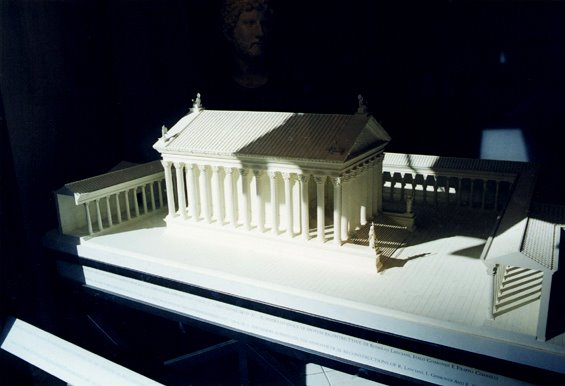
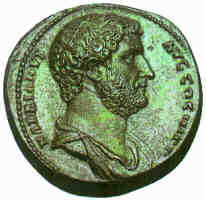
Temple of Hadrian nowadays


Temple of Hadrian like it was
There is a big chaos here because of the football world cup… flags everywhere, Italian team just got back home… you can imagine the enthusiasm in the streets , in the squares… I couldn’t sleep last night! … Good! Well… world cup is ok but nevertheless neither an American nor a Canadian replays to my posts! Italy is only for football? I don’t think so… there are so many other things to learn about Italian people, specially if you’d like to get here to spend a week in my beautiful country.

Someone from outer galaxies?


The web Universe is very like physical Universe, galaxies and stars scattered in big oceans of nothing in big oceans of empty space. I’m here waiting for someone from outer galaxies. Is there someone English speaking who is so kind to drop me a line? I’d be very happy! I can easily find some Italian speaking readers on my sites in Italian but never got one English speaking… can you help me? Better if you are interested in Italian Language or if you like conversation… but whoever you are you are welcome!

Wednesday, July 05, 2006

DESPERATE SEARCH FOR READERS


No posts on my blog till Tuesday June 27, It’s time to restart my search (I’d say desperate search) for someone interested in Italian language or conversation. I just started another blog (a MSM blog) similar to this one, you know, MSN blogs, when you post a new entry, shows the name of your blog on a special page. This procedure is useful to improve the blog visibility… but pages that show the updated blogs are different for each language… and, because of my residence country, when I update my blog I get visits (sometimes up to 10 or more a day) but only from Italy… and Italians don’t have to learn Italian… That’s whay now I’m back to my older English blog “Italian Culture in Pills”.

Tuesday, June 27, 2006

SIX ITALIAN TV CHANNELS ON MY SITE

Dear friends, in the restyling of my site “HOW TO LEARN ITALIAN”
I restarted “watch Italian TV on my site” service. Now six channels are available, for each of them I list also the specific web site:
1) Rai News 24 - site http://www.rainews24.rai.it/
2) Rai Utile - site http://www.raiutile.rai.it/
4) 3 Channel - site http://www.3channel.it/
5) Repubblica TV - site http://multimedia.repubblica.it/
6) Vatican TV - site http://www.radiovaticana.org/
The same service is available also in my Italian site “ESSERE IN DUE” http://xoomer.alice.it/eventually/

Saturday, June 10, 2006

ITALIAN TV ON MY SITE "HOW TO LEARN ITALIAN"

If you are interested in watching Italian news TV or Italian sport TV you can now watch RAI NEWS 24, a 24/7 news channel in Italian, and RAI SPORT, a 24/7 sport channel in Italian, on my site "HOW TO LEARN ITALIAN"

Friday, June 09, 2006

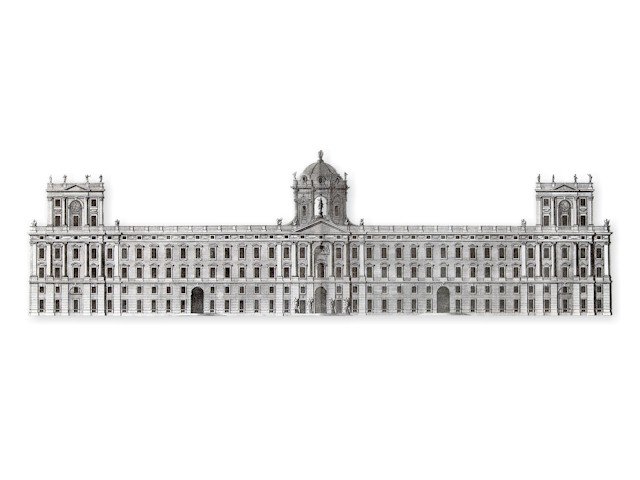
Royal Palace of Caserta

The ruling classes of eighteenth century Europe constituted a single nation whose homogeneity had not been equalled in preceding centuries. From Paris to Saint Petersburg, from Berlin to Naples, clear signs of this are found in customs such as the universal diffusion of the French language, in the sophistication of the aristocracy and the intellectual classes, as well as the philosophy of the Enlightenment or in the Masonic orders. Symbols of regal patronage and splendour, the palaces survived revolutions, bombardment and neglect, and thus represent the most tangible element of the grandness which lived in them.

http://www.reggiadicaserta.org/

Sunday, June 04, 2006

She wolf of Rome

LIVIUS I-4
But the Fates had, I believe, already decreed the origin of this great city and the foundation of the mightiest empire under heaven. The Vestal was forcibly violated and gave birth to twins. She named Mars as their father, either because she really believed it, or because the fault might appear less heinous if a deity were the cause of it. But neither gods nor men sheltered her or her babes from the king's cruelty; the priestess was thrown into prison, the boys were ordered to be thrown into the river. By a heaven-sent chance it happened that the Tiber was then overflowing its banks, and stretches of standing water prevented any approach to the main channel. Those who were carrying the children expected that this stagnant water would be sufficient to drown them, so under the impression that they were carrying out the king's orders they exposed the boys at the nearest point of the overflow, where the Ficus Ruminalis (said to have been formerly called Romularis) now stands. The locality was then a wild solitude. The tradition goes on to say that after the floating cradle in which the boys had been exposed had been left by the retreating water on dry land, a thirsty she-wolf from the surrounding hills, attracted by the crying of the children, came to them, gave them her teats to suck and was so gentle towards them that the king's flock-master found her licking the boys with her tongue. According to the story, his name was Faustulus. He took the children to his hut and gave them to his wife Larentia to bring up. Some writers think that Larentia, from her unchaste life, had got the nickname of "She-wolf" amongst the shepherds, and that this was the origin of the marvellous story. As soon as the boys, thus born and thus brought up, grew to be young men they did not neglect their pastoral duties, but their special delight was roaming through the woods on hunting expeditions. As their strength and courage were thus developed, they used not only to lie in wait for fierce beasts of prey, but they even attacked brigands when loaded with plunder. They distributed what they took amongst the shepherds, with whom, surrounded by a continually increasing body of young men, they associated themselves in their serious undertakings and in their sports and pastimes. Translated by by Rev. Canon Roberts, Everyman's Library (London: J.M. Dent and Sons, 1912)

Friday, June 02, 2006

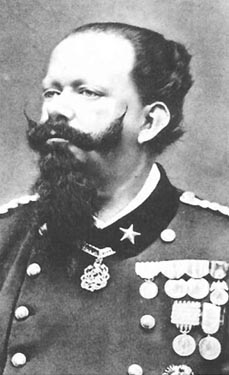
Majesty plural in 1859

Vittorio Emanuele II - King of Italy


Camillo Bneso di Cavour Prime Minister

Napoleon III

In Italy, when we speak with persons of our level or in a friendly conversation we use the “tu”, that is we address to the interlocutor in second person and use familiar expressions like “ciao”.

A) - Ciao! E’ un piacere incontrarti!
B) - Ti ringrazio, come stai?
A) – Io bene, e tu?
B) – Adesso ho fretta, scusami… chiamami se vuoi!

A) - Hi! It’s a pleasure to meet you!
B) – Thank you, how are you?
A) – Fine, and you?
B) – I’m sorry but I’m in a hurry… call me, if you like!

When we address to important persons or to strangers we don’t use the “tu” but the “lei”, that is we address to the interlocutor using the third person to the feminine, in this case we don’t use “ciao” but a less familiar expression like “salve” (latin expression used till Roman period).

A) - Salve! E’ un piacere incontrarla!
B) - La ringrazio, come sta?
A) – Io bene, e lei?
B) – Adesso ho fretta, mi scusi… mi chiami se vuole!

In Italy was also used another kind of expression “of regard”, that is the “voi”, today used only with very old persons that used it at their times. Using “voi” we address to the interlocutor using the second person “but to the plural”. In this case the pronoun subject of common use is “lei” (Lei mi ha detto…) but when we address persons of high rank we use “Ella”, with “E” capital. The previous conversation would sound therefore:

A) - Salve! E’ un piacere incontrarvi!
B) - Vi ringrazio, come state?
A) – Io bene, e voi?
B) – Adesso ho fretta, scusatemi… chiamatemi se volete!


In the written formal language the pronouns “of regard” are written with the beginning capital even if they are enclitic. For example:

“Signor Ministro,
ho avuto l’onore di incontrarLa lo sorso anno, quando Ella ha voluto manifestarmi il suo parere…”

“Mr. Minister, I have had the honor to meet you last year, when you liked to manifest your opinion to me…”

The very important persons like the Kings, in the official speeches, or the Popes, used (but now they don’t use any more) the plural instead of the singular, speaking to the first “plural” person (plural of majesty). About majesty plural a phrase remained very famous in Italy: "… nel mentre rispettiamo i trattati, non siamo insensibili al grido di dolore che da tante parti d'Italia si leva verso di noi" (”… meanwhile we respect treaties, we are not insensitive to the pain outcry that is coming towards us from many countries of Italy"). It’s a phrase pronounced from Vittorio Emanuele II, the King of Sardinia on January 10, 1859, this phrase means that, with the support of Napoleon III, the King of Sardinia could have assumed military initiatives against Austria in order to finally create the kingdom of Italy. The speech was received with enthusiasm. The First Minister of the King of Sardinia, the Count (Earl) Camillo Benso di Cavour had sent the text of the speech of the King to the preventive approval of Napoleon III using lower level formulas but the Emperor in person proposed this formula, which remained famous, like the phrase starting the Italian second independence war.

Tuesday, May 30, 2006

Today I got an e-mail!

Today I got an e-mail from abroad! According to my statistical sites probably this mail comes from “Cote d’Ivoire”. I have to thank shaka0070 that sent me an e-mail that I appreciated very well and also suggested me the address of a website (for hosting) truly interesting. It doesn’t happen every day, indeed, to receive an e-mail from the visitors of my sites, specially if they are French speaking. My French is not perfect but, I‘m able to read, to write and also to speak French without too many difficulties. Thanks!
Si vous voulez m’écrire quelque chose aussi en Français je serai bien heureux de lire e, s’il est possible, de répondre aussi. Je souhaite une bonne permanence sur mon site à tous ceux qui aiment l’Italie et la langue italienne. Merci a tous!

Monday, May 29, 2006

Conciliation street and "spina di borgo"


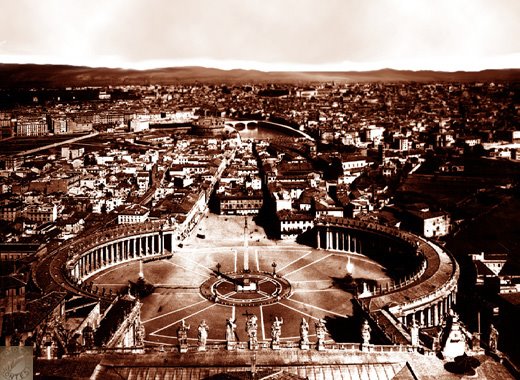
The first picture was taken in 1899 from the top of the Saint Peter’s Basilica. The “spina di borgo”, characteristic zone of the medieval and renaissance Rome, has been demolished in order to leave place to the Conciliation street inaugurated in 1937 (Conciliation between Italian kingdom and the Pope in 1929, you have to remember that Rome was ruled bay Popes till 1870 when the “bersaglieri” soldiers of Italian Kingdom entered the city and the Pope retired in Vatican, The popes till 1870 used to reside in “Quirinale” the big palace that staring from 1870 became the palace of the Kings of Italy, Savoia family). On the background the works of construction of the Palace of Justice are still not begun (building work started in 1889 and finished in 1910, architect Guglielmo Calderini).

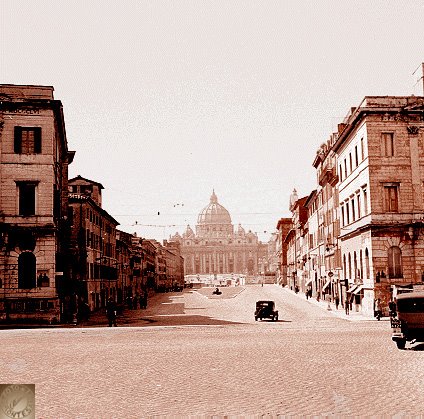
The second picture was taken in 1938 from Sant’Angelo Castle. You can see the Basilica of Saint Peter and Conciliation street not still completed. To the age of the photo the “spina di borgo” had been demolished.

The third picture shows Conciliation Street that was opened in 1937. There are aligned on the way “Santa Maria in Transpontina” very ancient church, rebuilt in 1566 (renaissance facade of G.S. Peruzzi, son of Baldassarre, finished in the 1587 from Mascherino); the palace Torlonia, already Giraud, reproduction in reduced scale of the papal “cancelleria”; the palace of the Convertendi, erected in the second half of the XVI century, demolished, moved and here reconstructed in 1937. In front of this palace there’s the palace of the Penitenzieri, attributed to Pontelli (1481), but almost rebuilt (in the inside, frescoes attributed to the Pinturicchio). The demolition of the “spina di borgo” has destroyed the effect produced by the opening unexpected of Saint Peter Square beyond the buildings of the “spina”. Saint Peter square, masterwork of architecture of Bernini (1656-1667), is an immense ellipses 240 meters width. The 284 colossal columns and the 88 pillars altogether form 3 covered galleries 17 meters wide, crowned from 140 statues of saints and from the great coats of arms of Alexander VII. In bottom to the right porch there is the bronze door of the Vatican palace. To the center of the public square between the two beautiful fountains, there’s an obelisk 25,50 meters high, based on the back of four bronze lions, placed on the high pedestal. This obelisk in the Middle Age was called “aguglia”, and people believed that on the top, in a gold urn, the ashes of Cesar were placed.